 |
| |
|
|
|
| |
|
|
|
| |
|
|
|
| |
1890
JULES DAMOIZEAU (DAMOIZED) ( - )
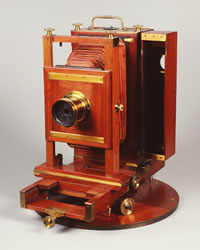
Damoizeau built what
has been suggested as the first panoramic camera,
which is untrue. The Cyclographe (right)
took photographs encompassing a full 360º and was one of
the better panoramic cameras of the day. It
was a collapsible bellows-camera and contained a pointed punch
which would strike and thereby identify each new exposure on
the roll prior to its passing before a slit at the shutter.
The dimension of the
roll film was 80cm by 8.5cm and operated via a mechanism driven
by a key-wound clockwork. The camera turned on the tripod as
the film was fed past the shutter in the opposite direction
to the camera's turning.
In 1894 Damoizeau developed
a panoramic stereoscopic camera with twin-lenses, twin-spools
and twin -slits. Most panoramic cameras provided a view of at
least 110º, with some, like this one providing for a full
circle. |
|
| |
Damoizeau's
Cyclographe (above) of 1890 |
Image
Source: George Eastman House
|
|
|
|
| |
|
|
|
| |
|
|
|
| |
1890
CHARLES PHILIP BESELER (1840 - 1908) |
|
|
| |
The Charles Beseler Company,
founded in 1868, manufactured a variety of instruments both in the optical
field as well as in the medical. His products included magic lanterns,
lanterslides, dissolving stereopticons
and stereopticons specifically for museum use. In 1890
Beseler designed and built a magic lantern which swivelled,
turned and tilted. It sat on a single post. The Charles Beseler Company
is still in existence today [2007] and is noted for their products quality
and long-lasting performance. In the mid-twentieth century the company
expanded to the amateur field of photography and darkroom equipment which
included the 45-series enlarger.
|
|
| |
|
|
|
| |
|
|
|
| |
1890
THE LENOX LYCEUM |
|
|
| |
Did a presentation
of a Tachyscope projection take place at the Lenox
Lyceum in New York City on April 7, 1890? Was it the Tachyscope
of Dickson or Anschutz? And were Muybridge’s photographs used? These
questions may never be adequately answered to satisfy all who ask. However,
one thing is for sure; there was apparently a presentation, and it was
with a Tachyscope, likely that of the Edison labs,
made by Dickson.
Chronicler Gordon Hendricks in his exhaustive work The Edison
Motion Picture Myth has presented some impressive details,
but as he himself points out, “Since an exhaustive
search has discovered no other reference to this projection . . . we
can assume that such a projection occurred." (p92).
The presentation is said to be the sponsored work of Edison, at the
Lenox Lyceum, which was at one time the Panoramic Building on Madison
Avenue, New York City.
It is also reported to have been a public motion picture projection,
although as it turned out only reporters saw the pictures move. The
event was certainly well documented, having made it’s way into several
daily newspapers including the New York Herald, Sun
and World, as well as other magazines and weekly newspapers.
Hendricks documents a report from a writer of the Western Electrician
published on April 12; |
|
| |
|
|
|
| |
"The
effects produced are indeed wonderful, and in splendor outrank anything
ever seen in this country. A magic lantern of almost unimaginable power
casts upon the ceiling from the top of the tower such pictures as seen
to be the actual performances of living persons.� |
|
| |
|
|
|
| |
Could this have been
only a preview for the press as Hendricks suggests? The strong suggestion
has also been made that the photographs of Muybridge
could have been what were shown that day. Photographs
made and shown in the Edison lab to this time, where well known as being
microscopic and not suitable for full projection in any projector he
had. This bides well then for the hint that Muybridge may have provided
such photos for the event at the Lenox Lyceum.
Interestingly, The General Magazine and Historical
Chronicle, published through the University of Pennsylvania
where Muybridge had worked earlier, reported regarding the photographs
of Muybridge, that Thomas Edison had used, “Muybridge’s
motion photographs of running horses . . . [as] his first continuous
movie on a strip film.� We have not come upon any
other references either, regarding this event, and must conclude from
what evidence does exist, that this presentation did in fact take place.
We reserve judgment however on whether Muybridge’s photographs were
used. |
|
| |
|
|
|
| |
|
|
|
|
|
|
| |
 |
1890
HERMANN CASLER (1867 - 1939)
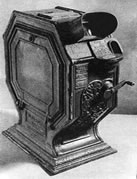
Casler’s
Mutoscope perhaps typifies the peepshow in its
purest form. A simple motion picture viewing machine
capable of ‘flipping’ pictures of successive phases were passed
before the viewing area as a crank is turned. Photographs
were mounted radially on an axle and when rotated or turned, each
photograph was held in sequence just long enough to be seen before
being replaced by the next. No matter how fast the handle was turned,
the pictures were held at a rate of between 16-18 frames per second.
This had been determined as the minimum necessary for persistence
of vision to be achieved.
The principle of persistence of vision is most simplified and understood,
with flipbook animation, which the Mutoscope demonstrated
accurately. Mutoscope Parlours were the rage in
the 1890’s throughout America and remained so until around 1910.
As a single-viewing device, the Mutoscope could
never compete (as could any peepshow) with the advent of projection,
to larger audiences. The photographs were taken with the Mutograph,
one of the earliest motion picture cameras. |
| Hermann
Casler's Mutoscope (above) was one of the
first successful nickelodeons to commercially exploit motion pictures.
This original coin-operated peep show machine housed a roll of photographs,
which were turned by the handle after a nickel was deposited in
the slot (hence the name nickelodeon). Like many of it's
competitors, the Mutoscope was limited to one viewer
at a time, and found it's greatest market in penny arcades.
(Image Source: Toronto Reference Library) |
|
|
| |
|
|
| |
Casler, along with William
K. L. Dickson of the Edison Laboratories, and Harry Marvin and Elias Koopman
joined forces to become the American Mutoscope and Biograph Company. Casler
designed and built the Biograph for AMBC. This
projecting apparatus used non-perforated film of a much larger frame area
than was customary at the time, resulting in a much sharper image. For
more on The American Mutoscope and Biograph Company SEE
AMBC 1896. |
|
| |
|
|
| |
|
|
| |
|
|
|
| |
| 1891
WILLIAM KENNEDY LAURIE DICKSON (1860 - 1935)
Dickson near-finishes
the Kinetoscope (Motion Picture Viewer, or Peepshow)
for Edison, who went on to patent the device. The Kinetoscope
was the first 'continuous-film' motion picture projector, as well
as the first time perforated film was used in projection.
The films were photographed
in the Kinetograph which was the first Celluloid
film motion picture camera, again invented by Dickson in the Edison
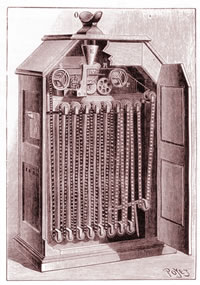
laboratories, 1888. In the Kinetoscope, a fifty-foot
loop of positive images was permanently threaded on a series of
rollers in the machine.
A diffused light behind
the film illuminated the frame in position at the viewing hood.
When a crank was turned the film advanced and an intermittent
shutter interrupted the light as each frame changed.
In commercial installations
where it's competitor was the flip-book Mutoscope,
a coin operated control blocked and unblocked the light at the
beginning of the brief presentation. To obtain enough film for
1.5 minutes of operation, Dickson had slit a two and three-quarter
inch wide length of film. This produced two 25-foot strips, each
35mm wide, which Dickson spliced together.
|
|
| |
The Kinetoscope
(above) with door open to show the fifty feet of film needed
for 1.5 min.
|
| |
|
| To
ensure that the film advanced without slipping, he perforated the
edges and used toothed sprocket wheels to impart regular motion.
Edison contracted Eastman to manufacture film to these specs before
the machine went into commercial production, and thus, the 35mm
motion picture film standards were established. Edison’s public
premiere of the Kinetoscope took place at the Orange
laboratory to a gathering of the National Federation of Women’s
Clubs. The event was chronicled by the Orange Chronicle as; |
| |
|
| “
. . . after the close of the entertainment a large number of the
ladies were, by special invitation, driven down to the laboratory,
where Mr. Edison himself was present and exhibited to them the kinetoscope,
the new invention that he is about perfecting, by which the gestures
of a speaker are accurately reproduced, while the spoken or sung
words are reproduced by the phonograph.� |
| |
|
|
|
| |
|
|
| |
|
|
|
| |
|
|
|
| |
1891
WILLIAM EDWARD FRIESE-GREENE (1855 - 1921) and MORTIMER EVANS ( - ) |
|
| |
Evans was a co-worker
and colleague of Friese-Greene. Evan’s efforts in the improvement of their
projector were for the most part centered on the intermittent movement
of the film strips. As Evans stated; “The objects
of the present invention are to simplify the means by which the successively
adjacent or following portions of a sensitized strip are caused to be
presented in position for exposure, arrested in position and removed from
position so as to allow the strip to be more gradually advanced. The advance
of the strip to be effected directly from the main shaft in lieu of intermittently
operating escape devices independently and momentarily operating when
released from the control of such shafts.� |
|
| |
|
|
|
| |
Friese-Greene
had earlier produced three separate experimental films of varrying guage
(60, 65 and even 155mm). The one shot on 155mm film at Hype Park was an
attempt at stereoscopic motion. It was shot at a rate of only 5 frames
per second due to the pressure of the advancing filmstrip, and does not
result in fluid motion. |
|
| |
|
|
|
| |
|
|
|
| |
|
|
|
| |
1891
LOUIS ARTHUR DUCOS DU HAURON (1837 - 1920)
Du Hauron completes his process
for Anaglyph Stereoscopic Photography, patenting it
this year. The system uses green and red filtration (European).
To show his system publicly he offers Magic Lantern
shows.
AUTHOR: Anaglyph
Stereo Photography involves an attempt to create 3D images
made from two photographs that are taken the same distance apart as
the human eyes --- 2.5 inches or so. Illusion of depth is simulated
using a red colour field of the left photo and combining it with the
right photo (green). Western colours are typically blue and red, whereas
in Europe red and green were established early on. The patron or viewer
wears the same coloured glasses to see the effect --- red in the left
eye and green or blue in the right lens. Anaglyph is taken from the
Greek language and two words are used to create it --- 'sculpture' and
'again' - in this case to re-sculpture a photograph or picture.
|
|
| |
|
|
|
| |
|
|
|
| |
|
|
| |
|
|
| |
 |
1891
FREDERIC EUGENE IVES (1856 - 1937)
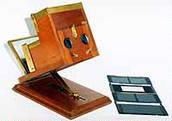
Ives
had designed a colour camera he called a Photochromoscope.
Photographs were taken using three distinct colour filters and were
again used after development to view the photographs. A pioneer
in the colour process, Ives gave us this (left) stereo
Cromoscope. It had an adjustable viewer for special
3 colour separation transparencies. (Image
Source: Lionel
Hughes Photographica) |
| Ives's
Cromoscope Viewer |
|
|
|
| |
|
|
| |
|
|
| |
|
|
|
|
|
|
|
| |
 |
1891-1892
ALBERT LONDE (1858 - 1917)
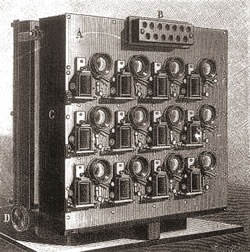
Adding three more lenses
to his camera of 1882 [SEE LONDE
1882], Londe now uses twelve lenses to photograph a succession
of images of patients in a variety of movements. The purpose;
the study of muscle-movement. His work in this field was completed
at Salpetriere hospital in Paris just as it was in 1882. Exposures
lasted from one and a half seconds to several seconds.
A year later in 1893 Londe
had his work in chronophotography within the
medical field published (La photographie médicale:
Application aux sciences médicales et physiologiques,
Gauthier-Villars, A. Londe, 1893 ). This is the first
book published on medical photography. The
book was illustrated with his work and was 220 pages in length.
In 1898 Londe published a slightly larger volume (Traité
pratique de radiographie et de radioscope: technique et applications
médicales, Paris, Gauthier-Villars, A. Londe., 1898).
Londe published six journals in all and worked with Dr. Jean-Martin
Charcot who was considered the leading French neurologist of
the century. Charcot was an early teacher of Freud. |
| Albert
Londe's 12-lens camera of 1891 |
The camera was illustrated
(left) in the journal 'La Nature',
1893. |
|
|
| |
|
|
|
| |
|
|
| |
|
|
|
| |
|
|
|
| |
1892
GEORGES DEMENY (1850 - 1917) |
|
|
| |
Demeny, who worked alongside
Marey at the Station Physiologique, built the Photophone
for photographing, and the Phonoscope for
projecting. Again, even with Celluloid available (and
used by them since 1888), Demeny used a glass disc which contained the
chronophotographs (between 18-24 around the circumference), and projected
them on the screen. This process is reminiscent of Muybridge's Zoopraxiscope,
and was actually an improvement on Anschutz's Electrotachyscope.
Demeny later this year patents the Phonoscope (without
Marey's involvement). |
|
| |
| |
The Phonoscope was shown this year at the
Exposition Internationale de Photographie de Paris
and Demeny considered producing the machine for commercial
use. The discs were 42cm in diameter with his chronophotographs
placed around the circumference, typically eighteen of them.
When Demeny began his company for manufacturing the Phonoscope
(Société de Phonoscope), Marey withdrew completely
from his relationship with Demeny and fired him from Station
Physiologique. Demeny would create and build his own camera
he called the Biographe, with his 'Beater
Mechanism' which transferred the film.
Georges Demeny changed the name of the Phonoscope
to the Bioscope in 1895, began a business
partnership with Leon Gaumont to manufacture the Bioscope
(1895), and had Alfred Molteni make his projecting lanterns.
The Biographe had no future and was not produced
beyond 1896 however Gaumont did successfully exploit the beater
mechanism concept after Demeny's retirement in the early 20th
century.
|
| |
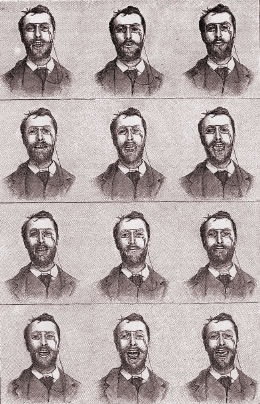
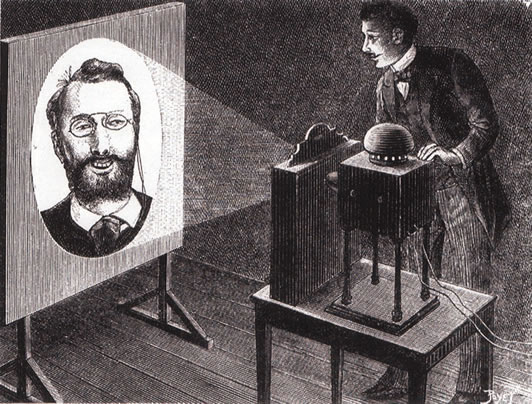
| Below
(left) is an etched-rendering (of Georges Demeny) of
twelve of the chronophotographs as they would have appeared on
a disc. The etching is from the magazine La Nature
that published them and below (right) we see a corresponding
engraving of how they appeared once projected through the Phonoscope. |
| |
|
| |
 |
The La Nature publication
citing Demeny's work with the Phonoscope
(above - left and right) was entitled 'Talking
Photographs' and reported the use of up to 24 chronophotographs
"pronouncing words and
phrases". (La Nature, September
1, 1892, identifying British Patent #15709).
In the above strip we can clearly see Demeny moving
his mouth as if speaking.
Using
the twelve images from the La Nature proof
sheet (above), we have reconstructed (left)
what Demeny may have looked like through the Phonoscope
in 1892. With the Photophone for photographing and
the Phonoscope for projecting, these chronophotograph
etchings were placed around the circumference of the
disk and when projected, gave the appearance of movement.
Rather than for entertainment, chronophotographs were
born out of a scientific interest.
|
| |
|
|
|
|
| |
|
|
|
| |
|
|
| |
|
|
| |
1892
MAXIMILLIAN SKLADANOWSKY (1863 - 1939)
Skladanowsky
was a German artist who along with brother and dad, created a camera
and projector in one (a chronophotographic device),
making a film this year in Germany. The film was a total of forty-eight
frames and were of his brother Emil. He called it his Bioskop
and by 1895 it was projecting two rolls of film at the same time.
Skladanowsky used George Eastman's Kodak film.
As a 16 year old, Skladanowsky learned the craft of the magic
lantern presentation with his father Carl as he introduced
his Nebula Pictures. These were magic lantern shows
of natural disasters, which he showcased at different venues around
Germany. The Berlin Town Hall and Apollo Theatre in Friedrichstrasse
to name two. |
|
| |
Maximillian
Skladanowsky |
| |
|
|
|
| |
|
|
|
|
|
|
| |
1892
CHARLES-EMILE REYNAUD (1844 - 1918)
In
Paris, Reynaud opens his Theatre Optique Movie
Theatre at Musée Grevin. Instead of using photographs,
Reynaud returns to the use of hand-painted images. Nostalgia, so
soon. Some information is available to suggest that this could be
the theatre once owned and used by Robert Houdin.
That Georges Melies purchased the actual Houdin
Theatre in 1888 and maintained it into the twentieth century
makes this doubtful. |
| |
|
|
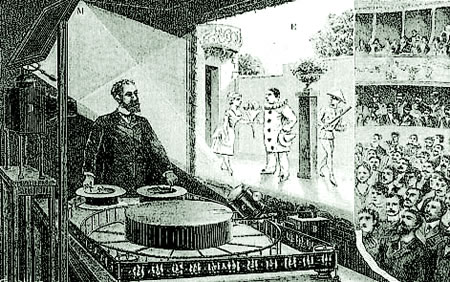
| The Théâtre
Optique of Emile Reynaud (shown in operation above) was designed
and built in 1887 and patended in 1888. This presentation in 1892
at the Musée Grevin was produced by Reynaud who acted as
projectionist, which was typical of early film pioneers.
This etching offers a representation of how it all may have looked
like during the show. |
|
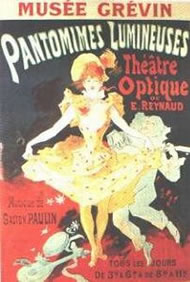
Promoted as
'Pantomimes Lumineuses', this poster (above) drew audiences to what
has been called the first publicly shown animated pictures on a
strip or band. |
|
|
|
The above image idetifies how the machine worked and operated:
The operator worked two spools which contained a long band or
strip of leather on which painted images on gelatine squares were
placed and secured. Between each picture were perforations that
matched up with pins on the larger revolving wheel that housed
little mirrors.
Each picture aligned with a mirror and was projected up onto
a larger mirror, which was re-directed onto a transluscent sheet,
which was between the projector and the audience. A Magic
Lantern was employed to cast a background static image
onto the sheet as well as provide additional illumination and
another 'dimension' to the overall effect.
Reynaud painted the images having grown up in and apprenticed
in a Magic Lantern producing environment. These
animated performances at Musée
Grevin lasted up to fiften minutes at times and involved between
500 to 700 individually painted frames.
Reynaud died in 1918 and while being deeply depressed destroyed
his only Théâtre Optique. Only two
of his strips survive today. |
|
|
| |
|
|
|
| |
|
|
| |
|
|
|
| |
1892
ETIENNE-JULES MAREY (1830 - 1904) |
|
|
| |
Marey presented a form
of cinematography by projecting a series of sixty or
more positive images onto a screen. The images were printed onto a transparent
band and projected with electric light. Marey was presenting to the Academie
des Sciences at the time, however it is not clear if the Academie saw
this presentation or only heard of it. From further research, it would
appear that he did project these images, but not within the presence of
the Academie.
N.B. Gernsheim (The History of Photography,
pp334) states clearly that Marey actually projected photographed
motion in cinematographic form. However he also states
Marey only described this to the Academie. Braun (Picturing Time,
pp173) states that Marey promised a projection show but it never
happened even though the pictures were cut and attached to a rubber fabric
in an attempt to provide projection. The photographs
were also not equidistant, however this was achieved in 1896 (Gernsheim).
George Gilbert (Collecting Photographica, pp 237) claims Marey
used a Celluloid band but places the event in 1893. |
|
| |
|
|
|
| |
|
|
|
| |
|
|
| |
|
|
|
| |
 |
1892
LEON GUILLAUME BOULY (1872 - 1932)
Prior to the Lumiere
brothers naming and patenting their 'Cinematographe',
Bouly had designed and built a machine he described as a "reversible
device of photography and optics for the analysis and synthesis
of motions, [named] cinématographe Léon Bouly".
He had named his a 'Cinematographe' in a second
patent in 1893, but fell into financial hardship and in 1894
the patent lapsed. The Lumiere's liking that name, patented
the name, and applied it to their 'Cinematographe'.
Without perforations in the
film roll, the sequencing was not smooth but jerky and failed
to live up to the description found within the patent; 'to
obtain automatically and without interruption a series of analytical
negatives of movement'.
The second patent filed in
1893 claimed that the Cinematographe would
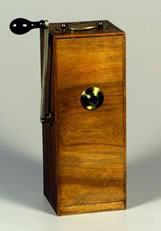
be capable of both filming and projection. Bouly's Cinematographe
of 1892 was a camera-only machine. Two of these cameras are
extant and can be found at the Conservatoire National des Arts
et Métiers in Paris. |
| Bouly's
Cinematographe (above) ( or cine-camera) of 1892 |
Image Source:
The
George Eastman House Technology Archive |
| |
|
|
| |
|
|
| |
|
|
|
| |
|
|
|
| |
1892
Sir CHARLES VERNON BOYS (1855 - 1944) |
|
|
| |
Boys advanced the work
of Ernst Mach by photographing flying bullets at 1500 mph. Boys'
work was conducted at the Royal College of Science and managed to provide
fairly clear photographs of the bullets penetrating glass and other
substances. Boys reduced the duration due to sparks, to approximately
1/10,000,000 [one ten millionth] of a second. The rifle bullet moved 1/400th
of an inch at the moment the picture was taken.
|
|
| |
|
|
|
| |
|
|
|
| |
1893
- THE KINETOSCOPE
The Kinetoscope is seen by the public for the first time
when it is demonstrated at the Brooklyn Institute of Arts and Sciences
in New York on May 9. |
|
| |
|
|
|
| |
|
|
|
| |
1893
ETIENNE-JULES MAREY (1830 - 1904) |
|
|
| |
Marey employs the use
of the sun for lighting in a projector. The world's first solar projector. |
|
| |
|
|
|
| |
|
|
|
| |
|
|
| |
|
|
| |
 |
1893
THOMAS ALVA EDISON (1847 - 1931)
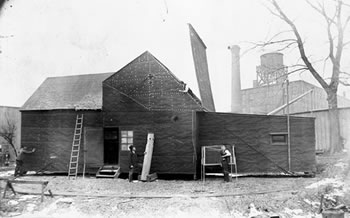
Edison builds the first
movie studio known of. He calls it the 'Black Maria'
and the next year opens his first picture house in New York City.
The Black Maria was situated in New Jersey.
Readers who are aware
of the movie moguls (studio owners) of the 1920's, 30's and 40's
who developed out of the early years of filmmaking, will recall
the fact that the movie studios at that time owned and operated
their own chain of movie theatres and houses across the country
during those decades. The commercial advantage of this practice
was foreseen, and begun by Edison as early as 1893.
Edison presents his peep
show Kinetoscopes to the U.S., England and France. |
The
Black Maria (above) was nothing more than
a shack, and was used in the 'production' of some of Edison's
very first films and tests such as 'Fred Ott's Sneeze'.
It was painted inside and out with black paint so as to keep out
unwanted light.
The
window on the slanted roof was used to flood the subject with
light. Edison made many other experimental films using his employees
as actors.
|
|
|
| |
|
|
| |
|
|
| |
|
|
|
| |
|
|
|
| |
1893
EADWEARD JAMES MUYBRIDGE (1830 - 1904) |
|
|
| |
Muybridge attends the
Columbian Exposition at Chicago and provides a work entitled 'Descriptive
Zoopraxography'. The Zoopraxiscope is the star
of the show as Muybridge presents his work at his Zoopraxigraphicall
Hall. |
|
| |
|
|
|
| |
|
|
|
| |
| |
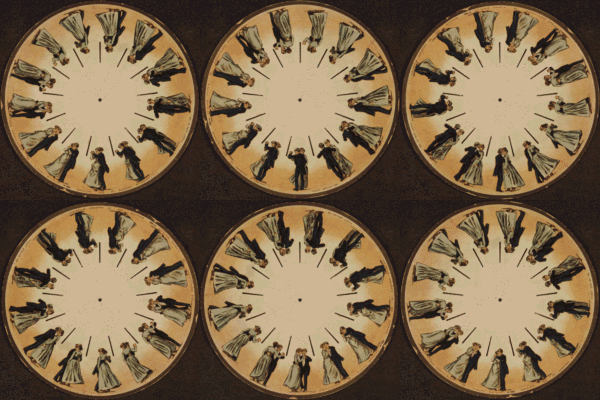
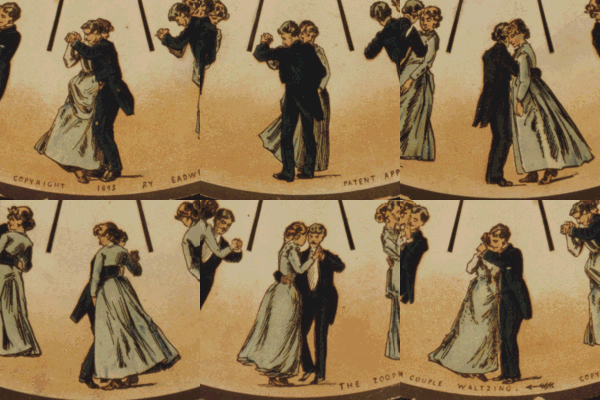
ZOOPRAXISCOPE
WALTZING COUPLE
The
Zoopraxiscope operated by projecting images (drawn
from photographs in some cases) rapidly and in
succession onto the screen.
The
photographs were painted onto a glass disc for
the Zoopraxiscope (even though the Hallotype
photographic process allowed photographs
to be placed onto glass). When rotated and projected within the
Zoopraxiscope the spinning disk provided an illusion
of motion.
A fine
example of the early purpose of the Zoopraxiscope was
to distinguish motion by the use of individual images (left
& right). |
|
|
|
| Muybridge's
Zoopraxiscope Plate Disks were hand painted by Thomas Eakins and
also Erwin Faber. These two animations show the illusion created
by the 'Waltzing Couple' -- full disk (above left), and
the view through the Zoopraxiscope (above right). |
| |
|
|
| |
|
|
| |
|
|
| |
|
|
|
| |
1893
THOMAS HENRY BLAIR (1855 - 1919)
Blair
creates a photographic company but George Eastman puts him out of business
over a patent suit. Blair sets up shop in London under the name European
Blair Camera Company. |
|
| |
|
|
|
| |
|
|
|
| |
|
|
| |
|
|
| |
| 1894
WILLIAM KENNEDY LAURIE DICKSON (1860 - 1935)
Dickson uses the Kinetograph
to photograph Fred Ott, one of Edison's laboratory
workers, standing in front of the camera sneezing. This was
not another 'experimental film', but simply a publicity stunt
for a New York magazine. The magazine wanted still pictures
of a man sneezing to accompany a story. It
was catalogued as 'Edison Kinetoscopic Record of a Sneeze'
and has gone down into history as possibly the first 'cult'
film.
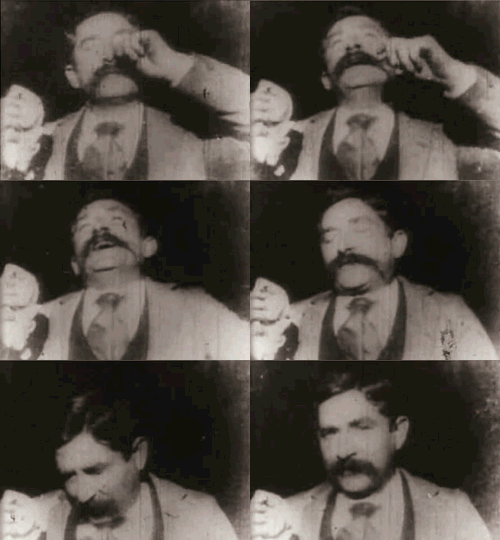
These four seconds
(right) are known the world over as 'Fred Ott's
Sneeze'. Ott later identified himself as the world's
first "film star".
The footage was
copyrighted by Dickson and cameraman William Heise (another
Edison employee) as a 'photograph' with the Library Of Congress
in January (it was actually a proof sheet containing 45 images).
|
|
|
The film footage originally was five seconds long and was photographed
at 16fps on 35mm film stock. The above frames are twenty-one
in all and have been re-constructed at 12fps for a 2.52 second-long
looped animation. Dickson and Heise filmed Ott in the Black
Maria. |
| |
| |
|
|
| |
|
|
|
| |
|
|
| |
|
|
|
| |
|
|
|
| |
1894
ROBERT WILLIAM PAUL (1869 - 1943) |
|
|
| |
Just prior to meeting
and teaming with Birt Acres, Paul was reproducing Edison’s Kinetoscope
on the English side of the Atlantic. Edison had failed to patent his Kinetoscope
in England alone. Paul re-produced the Edison machine as well as a camera
for shooting the film needed (because the Paul machine was not a licensed
Kinetoscope, Edison did not provide the standard film
required - Paul manufactured his own). |
|
| |
|
|
|
| |
|
|
|
| |
1894
THOMAS ALVA EDISON (1847 - 1931)
Edison has Jean Acme LeRoy
present selected films in private at the magic lantern office of the RIley
brothers in New York. |
|
| |
|
|
|
| |
|
|
|
| |
1894
BIRT ACRES (1854 - 1918) and ROBERT WILLIAM PAUL (1869 - 1943) |
|
| |
Co-inventors, Paul and
Acres team up to design and build the Kineopticon (some
writers and historians have pinned this event to 1896). This relationship
did not last very long (six weeks) after Paul discovered that Acres had
claimed the Kinetic Camera for himself. The Kinetic
Camera of Acres was closely modeled after the Kineopticon.
Acres had filed sole patent papers without Paul's knowledge. Acres was
one of the first filmmakers to produce in Germany. |
|
| |
|
|
|
| |
|
|
|
| |
|
|
| |
1894
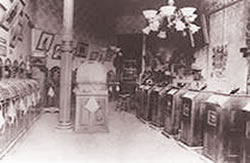
The first Edison
Kinetoscope parlour is opened in New York by the
Raff & Gammon Company.
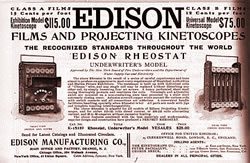
An
advertisement (right) for the Kinetoscope,
from page 242 of the The Moving Picture World,
June 15, 1907. The ad offered Class 'A" and 'B' films of 15
and 12 cents respectively, as well as 'projecting Kinetoscopes'
costing between $75 and $115.
|
|
|
Image
(left) of a typical Edison Kinetoscope Parlour Image
(right) From The Library of Congress. |
| |
|
|
|
|
| |
|
|
| |
|
|
|
| |
|
|
|
| |
1894
CHARLES FRANCIS JENKINS (1867 - 1934) |
|
|
| |
Along with the assistance
of Thomas Armat, Jenkins produces the first motion picture
projector with reeled film and electric light, the Phantascope.
This Phantascope was actually the work of R. Rudge back
in 1889 (SEE RUDGE 1889) and perfected
by Jenkins with roll film and electricity. An inventor by choice, Jenkins
was also working on his Vitascope, which had its debut
in 1896. In striking similarity as that of the Muybridge/Stanford bet,
Jenkins also took a wager regarding five horses in stride. Whether all
five left the ground at the same time was the question. The answer, according
to sources present, was to the affirmative. This footage taken by Jenkins
and shown in June of this year in Richmond, Indiana is another "first"
for the public showing category. In 1916 Jenkins will found the Society
of Motion Picture Engineers. |
|
| |
|
|
|
| |
|
|
|
| |
|
|
| |
|
|
|
| |
1894
JULES RICHARD (1862 - 1956)
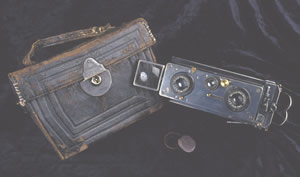
The
little known and rarely remembered Verascope by
Richard was an all-metal stereo camera, which remained in production
up until the mid 1920’s, far surpassing all other cameras produced
from this period. Scottish Explorer William Bruce used Richard’s
camera on his expeditions between 1899 and 1914.
Image
(right) of Jules Richard's stereoscopic camera from 1894.
(Courtesy Dr. David Munro, Director, The
Royal Scottish Geographical Society, The
University of Strathclyde, and Alan Dawson,Centre
for Digital Library Research, University of Strathclyde, Glasgow,
Scotland. |
|
| Richard's
camera took simultaneous double images on 12 pre-loaded glass plates.
The photographs appeared 3-dimensinal when viewed through a binocular
viewer. The camera and images from Bruce's explorations where donated
to the Royal Scottish Geographical Society by Bruce's granddaughter,
Moira Watson of Canada. |
|
|
| |
|
|
| |
|
|
|
| |
|
|
|
| |
1894
ALFRED MOLTENI ( - ) |
|
|
| |
Molteni was a Parisian
maker of projection lanterns including those used in Phantasmagoria.
Under contract to the Lumeire factory he manufactured lamphouses used
in their Cinematographique. |
|
| |
|
|
|
| |
|
|
|
| |
1894
ÉTIENNE-JULES MAREY (1830
- 1904) |
|
|
| |
Marey invents a slow motion
camera capable of shooting 700 frames per second. |
|
| |
|
|
|
| |
|
|
|
| |
|
|
|
| |
|
|
|
| |
|
|
|
| |
|
|
|
| |
|
|
|
| |
|
|
|

|
| |